

Close Menu
  • Main Home
  • About
    • Founder & CEO
    • The Challenge
    • Testimonials
    • In the Media
    • Gray Rhino Trademark Guidelines
    • Contact
  • Services
    • Speaking
    • Speaking Topics
      • TOP GLOBAL ECONOMY GRAY RHINOS
      • CLIMATE RISK GRAY RHINOS: STRATEGIC RESPONSES
      • GENDER AND RISK
      • THE RISK YOUR “FREE-FROM” FOOD BRAND CANNOT AFFORD TO TAKE
    • Workshop and Interactive Training Topics
      • RISK SKILLS IN THE FUTURE OF WORK
      • RISK FINGERPRINT FORENSICS
      • GRAY RHINO PROOFING YOUR FUTURE
    • Executive Masterclass – Risk Management
    • DCRO Risk Governance Institute
    • Earn the Mastering Gray Rhino® Governance Certificate
    • Strategic Advisory
    • NEW Microlearning Course: What’s Your Gray Rhino? [Personal version]
  • THE GRAY RHINO
    • Corporate Book Clubs
    • International Editions
      • Italian -Il Rinoceronte Grigio
      • Brazilian Portuguese -O Rinoceronte Cinza
      • Norwegian: GRÅ NESHORN
      • 灰犀牛 (Chinese Traditional Characters)
      • 灰犀牛 (Chinese Simplified Characters)
      • Korean: 회색 코뿔소가 온다
      • Hungarian: A szürke rinocérosz
    • Readers Guide
      • Media
  • YOU ARE WHAT YOU RISK
  • Gray Rhino Blog
    • The Horn
    • My Gray Rhino
    • Audio
    • Video
    • Quiz: How Rhino Ready Are You?
Facebook X (Twitter) Instagram
Trending
  • Constructing cognitive models using the gray rhino risk framework
  • Substack Gray Rhino Wrangler Short Series: the Big Ugly Debt Gray Rhino
  • Kerala’s Landslide Grey Rhino
  • IRM India Affiliate’s What’s the Risk?®️ – National Resilience In The Age of Polycrisis
  • Earn the Mastering Gray Rhino® Governance Certificate
  • The Gray Rhino microlearning course (personal version)
  • ARK Wealth Summit Hong Kong 2025: Reshaping Risk Awareness
  • On Substack: Wrangling this Gray Rhino Rampage
Facebook LinkedIn RSS
Gray Rhino & Company
Leaderboard Ad
  • Main Home
  • About
    • Founder & CEO
    • The Challenge
    • Testimonials
    • In the Media
    • Gray Rhino Trademark Guidelines
    • Contact
  • Services
    • Speaking
    • Speaking Topics
      • TOP GLOBAL ECONOMY GRAY RHINOS
      • CLIMATE RISK GRAY RHINOS: STRATEGIC RESPONSES
      • GENDER AND RISK
      • THE RISK YOUR “FREE-FROM” FOOD BRAND CANNOT AFFORD TO TAKE
    • Workshop and Interactive Training Topics
      • RISK SKILLS IN THE FUTURE OF WORK
      • RISK FINGERPRINT FORENSICS
      • GRAY RHINO PROOFING YOUR FUTURE
    • Executive Masterclass – Risk Management
    • DCRO Risk Governance Institute
    • Earn the Mastering Gray Rhino® Governance Certificate
    • Strategic Advisory
    • NEW Microlearning Course: What’s Your Gray Rhino? [Personal version]
  • THE GRAY RHINO
    • Corporate Book Clubs
    • International Editions
      • Italian -Il Rinoceronte Grigio
      • Brazilian Portuguese -O Rinoceronte Cinza
      • Norwegian: GRÅ NESHORN
      • 灰犀牛 (Chinese Traditional Characters)
      • 灰犀牛 (Chinese Simplified Characters)
      • Korean: 회색 코뿔소가 온다
      • Hungarian: A szürke rinocérosz
    • Readers Guide
      • Media
  • YOU ARE WHAT YOU RISK
  • Gray Rhino Blog
    • The Horn
    • My Gray Rhino
    • Audio
    • Video
    • Quiz: How Rhino Ready Are You?
Gray Rhino & Company
You are at:Home»Blog»The Horn»World Economic Forum Global Risks Report 2018
Image via World Economic Forum Global Risks Report 2018

World Economic Forum Global Risks Report 2018

0
By Michele Wucker on February 19, 2018 The Horn

When people ask me about the definition of a gray rhino, I often point to the top right-hand quadrant of the World Economic Forum’s annual Global Risks Report, which highlights risks that global survey respondents deem to be both highly likely and high impact.
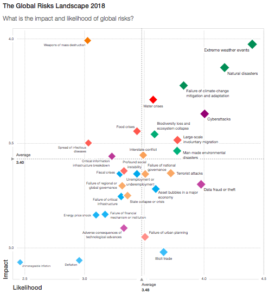
 

Image via World Economic Forum
The World Economic Forum Global Risks Report 2018 risk assessment

Because I think so highly of the report’s important role in drawing attention to obvious and likely risks that we should not ignore, I was honored to participate in the World Economic Forum Global Risks Report 2018 with an article on the relationship between cognitive biases and risk management. Here it is:

Cognitive bias and risk management

By Michele Wucker

Risk management starts with identifying and estimating the probability and impact of a given threat. We can then decide whether a risk falls within our tolerance limits and how to react to reduce the risk or at least our exposure to it. Time and again, however, individuals and organizations stumble during this process—for example, failing to respond to obvious but neglected high-impact “grey rhino” risks while scrambling to identify “black swan” events that, by definition, are not predictable.

New technologies and advances in data science have improved our ability to identify trends, assess risks and generate early warnings. But if business and policy decision-makers are to take full advantage of these new tools, we need a firmer handle on the reasons why people are more likely to react to some risks and ignore others. This behavioural element is crucial to managing risks effectively—to both recognizing the risks that confront us and then translating that knowledge into effective action.

Adjusting for bias in our risk assessments
Our brains play tricks that make some risks appear to be more or less likely than they are in reality. Being aware of the blinders that make it harder to recognize obvious risks allows leaders to counteract them, helping to prevent crises or at least mitigate the damage caused.

In deliberative situations such as a meeting of a corporate board or a legislative body, anchoring and confirmation biases can distort perceptions by assigning more weight to information and views presented early on. Leaders can offset these distortions by changing their processes to ensure that there are diverse voices around the table and by encouraging structured debate and constructive dissent. In other words, they can make it easier to consider a range of points of view that ultimately strengthens the choices they make.

One of the most pervasive cognitive blinders is the availability bias, which leads decision-makers to rely on examples and evidence that come immediately to mind. This draws people’s attention to emotionally salient events ahead of objectively more likely and impactful events.

Hyperbolic discounting leads some decision-makers to prioritize short-term goals that end up hurting long-term value. Examples include putting off crucial investments or kicking the can down the road on tough but necessary budget decisions in companies or governments. Structures such as short-term quarterly earnings cycles or relatively short political terms create perverse incentives that magnify the hyperbolic discounting bias.

When members of a decision-making group are too homogeneous it can hamper their ability to recognize and react appropriately to risk. Among other things, too little diversity can heighten confirmation bias and make it more difficult for individuals to speak out about risks for fear of disrupting consensus. Cultural factors can also play a role. One approach for any organization that needs more robust inputs is for leaders to solicit opinions ahead of meetings, or to anonymize key inputs required during meetings—for example, by asking people to put their ideas on slips of paper and then considering them all in a group.

From box-ticking to reflective action
Organizations often act decisively to counter risk only once a major breach, such as a safety catastrophe or hacking event, forces them to. Part of this is because humans discount the likelihood of worst-case scenarios happening, which can blind us to obvious dangers.

Too often boards and C-suites approach risk analysis as a standalone activity to be ticked off a list, but then fall short on mitigating the risks that their analysis has identified. Think of an employee derailing cybersecurity plans by inadvertently clicking on a phishing email because not enough was done to spread risk awareness from the C-suite to the wider organization. To prevent this kind of breach, risk management needs to come out of its silo and become as much an organic part of operations as budgeting and project management. Organizations must do better in educating teams on risk awareness. But they also need to make sure their cultures encourage employees to feel that they can speak out and be taken seriously enough for problems to be dealt with.

Global risks require action across multiple organizations, which means that often one of the risk-management challenges at this level is the absence of the same kind of levers and hierarchies that facilitate decision-making and implementation within single organizations. Steeper obstacles to collective action heighten the challenge of getting varied stakeholders and networks to coordinate in responding to global risks.

There are encouraging developments on this front. All kinds of actors are already thinking in new ways about who can do what to solve global problems. After the US federal government pulled out of the Paris Agreement on climate change, for example, more than 2,300 businesses, cities, states and other non-federal actors pledged to honour a commitment to cut emissions. Organizations such as the World Economic Forum bring together global public- and private-sector actors to share ideas and catalyse action. The creation in some countries of new types of corporations, which include social and environmental impact in their bottom-line calculations, is re-shaping the role of businesses in confronting global risks head-on.

From signals to action
Organizations across the private and public sectors need to take a fresh look at how and why individuals and groups assess and act on risks in the way they do. We cannot ignore the cognitive and behavioural factors in risk management if we are to avoid both black swans and grey rhinos. Individuals and organizations must work to overcome biases, make better decisions, create warning-signal systems and act cohesively when red flags are raised.

Increasingly rich data resources give us better tools to anticipate problems and to track our progress in dealing with them. But decision-makers need to work hard to help to ensure that all of this information leads to effective action. That means developing better listening strategies, like those of CEOs who actively canvass the views of millennials as important intelligence on market trends and the future policy environment that businesses will face. It also means developing ways of encouraging and rewarding decision-makers who take difficult, long-term decisions. Finally, it means better tracking of outcomes and metrics to hold businesses and governments accountable for their promises.

Michele Wucker is the author of The Gray Rhino: How to Recognize and Act on the Obvious Dangers We Ignore and a 2009 Young Global Leader of the World Economic Forum.

Originally published in the World Economic Forum Global Risks Report 2018.

  • Author
  • Recent Posts
Michele Wucker
Follow
Michele Wucker
Founder & CEO at Gray Rhino & Company
Michele Wucker is a policy and business strategist and author of four books including YOU ARE WHAT YOU RISK: The New Art and Science of Navigating an Uncertain World and the global bestseller THE GRAY RHINO: How to Recognize and Act on the Obvious Dangers We Ignore. Read more about her at https://www.thegrayrhino.com/about/michelewucker
Michele Wucker
Follow
Latest posts by Michele Wucker (see all)
  • Constructing cognitive models using the gray rhino risk framework - October 15, 2025
  • Substack Gray Rhino Wrangler Short Series: the Big Ugly Debt Gray Rhino - September 30, 2025
  • Kerala’s Landslide Grey Rhino - September 15, 2025
cognitive bias Global Risks Report risk risk reassessment World Economic Forum
Share. Facebook Twitter Pinterest LinkedIn Tumblr Email
Michele Wucker
  • Website
  • Facebook
  • X (Twitter)
  • LinkedIn

Michele Wucker is a policy and business strategist and author of four books including YOU ARE WHAT YOU RISK: The New Art and Science of Navigating an Uncertain World and the global bestseller THE GRAY RHINO: How to Recognize and Act on the Obvious Dangers We Ignore. Read more about her at https://www.thegrayrhino.com/about/michelewucker

Related Posts

Substack Gray Rhino Wrangler Short Series: the Big Ugly Debt Gray Rhino

On Substack: Wrangling this Gray Rhino Rampage

Gray Rhino Risks and Responses to Watch in 2024

Comments are closed.

YOU ARE WHAT YOU RISK
YOU ARE WHAT YOU RISK Book Cover Click to order YOU ARE WHAT YOU RISK: The New Art and Science of Navigating an Uncertain World (Pegasus Books, April 6, 2021)
Book A Keynote or Workshop
Speakers Connect Sidebar Ad Book Gray Rhino & Company Founder & CEO Michele Wucker to speak at your next event. For more information  click on the logo  to contact Speakersconnect.

DCROI Risk Governance Institute
DCROI logo NEW! Earn the Mastering Gray Rhino Governance Certificate. Learn about DCROI's growing library of courses, networking, learning, and development opportunities focusing on the positive governance of risk-taking and the practical aspects of risk governance needed to pursue corporate goals and fulfill the purpose of our organizations.
BOOKSHOP.ORG STORE
Bookshop.org logo Shop at Bookshop.org and support independent booksellers. Browse our lists on business, decision making, current affairs, and more.
About
About

Gray Rhino® & Company provides a simple yet powerful framework, training and tools to help individuals, organizations, and communities to better counter and overcome obvious but too often neglected challenges in business, life, and the world.

Facebook LinkedIn
GRAY RHINO TRACKER Sign Up
Subscribe below for exclusive insights and updates in our monthly newsletter, The Gray Rhino® Tracker.
©2016-2023 Gray Rhino & Company 5940 North Sheridan Road, Chicago, IL 60660
  • About
  • Privacy Policy
  • Contact

Type above and press Enter to search. Press Esc to cancel.

We use cookies on our website to give you the most relevant experience by remembering your preferences and repeat visits. By clicking “Accept”, you consent to the use of ALL the cookies.
Do not sell my personal information.
Cookie SettingsAccept
Manage consent

Privacy Overview

This website uses cookies to improve your experience while you navigate through the website. Out of these, the cookies that are categorized as necessary are stored on your browser as they are essential for the working of basic functionalities of the website. We also use third-party cookies that help us analyze and understand how you use this website. These cookies will be stored in your browser only with your consent. You also have the option to opt-out of these cookies. But opting out of some of these cookies may affect your browsing experience.
Necessary
Always Enabled
Necessary cookies are absolutely essential for the website to function properly. These cookies ensure basic functionalities and security features of the website, anonymously.
CookieDurationDescription
cookielawinfo-checkbox-analytics11 monthsThis cookie is set by GDPR Cookie Consent plugin. The cookie is used to store the user consent for the cookies in the category "Analytics".
cookielawinfo-checkbox-functional11 monthsThe cookie is set by GDPR cookie consent to record the user consent for the cookies in the category "Functional".
cookielawinfo-checkbox-necessary11 monthsThis cookie is set by GDPR Cookie Consent plugin. The cookies is used to store the user consent for the cookies in the category "Necessary".
cookielawinfo-checkbox-others11 monthsThis cookie is set by GDPR Cookie Consent plugin. The cookie is used to store the user consent for the cookies in the category "Other.
cookielawinfo-checkbox-performance11 monthsThis cookie is set by GDPR Cookie Consent plugin. The cookie is used to store the user consent for the cookies in the category "Performance".
viewed_cookie_policy11 monthsThe cookie is set by the GDPR Cookie Consent plugin and is used to store whether or not user has consented to the use of cookies. It does not store any personal data.
Functional
Functional cookies help to perform certain functionalities like sharing the content of the website on social media platforms, collect feedbacks, and other third-party features.
Performance
Performance cookies are used to understand and analyze the key performance indexes of the website which helps in delivering a better user experience for the visitors.
Analytics
Analytical cookies are used to understand how visitors interact with the website. These cookies help provide information on metrics the number of visitors, bounce rate, traffic source, etc.
Advertisement
Advertisement cookies are used to provide visitors with relevant ads and marketing campaigns. These cookies track visitors across websites and collect information to provide customized ads.
Others
Other uncategorized cookies are those that are being analyzed and have not been classified into a category as yet.
SAVE & ACCEPT